Key takeaways
New statutory union access rights
Employers must facilitate physical and digital workplace access from October 2026.
Strict timelines and formal processes for employers
Tight response and negotiation periods, CAC determination, and enforceable agreements.
Non-unionised workplaces face higher risk
Requests likely where no recognised union exists; refusals rarely sustainable.
From 30 October 2026, trade unions will have a new statutory right to access workplaces to meet, represent, recruit or organise workers (s59 Employment Rights Act 2025, which will introduce a new Chapter 5ZA into the Trade Union and Labour Relations (Consolidation) Act 1992).
While the Employment Rights Act 2025 sets out the basic principles and framework for these new trade union access rights, much of the practical detail will be found in a new Code of Practice, expected to come into force on 30 October 2026. Earlier this year, the government published a consultation on a draft Code of Practice, ‘Make Work Pay: draft code of practice on trade union right of access’, alongside its response to the 2025 consultation on this new right. That consultation has now closed, and we are awaiting the outcome and the final version of the Code of Practice.
This article provides a practical guide for employers in Great Britain (England, Wales and Scotland) on how this new right for trade unions to access workplaces and workers will operate in practice from 30 October 2026, highlighting areas of uncertainty and our thoughts on what they can do now to prepare.
How will the trade union access request process operate?
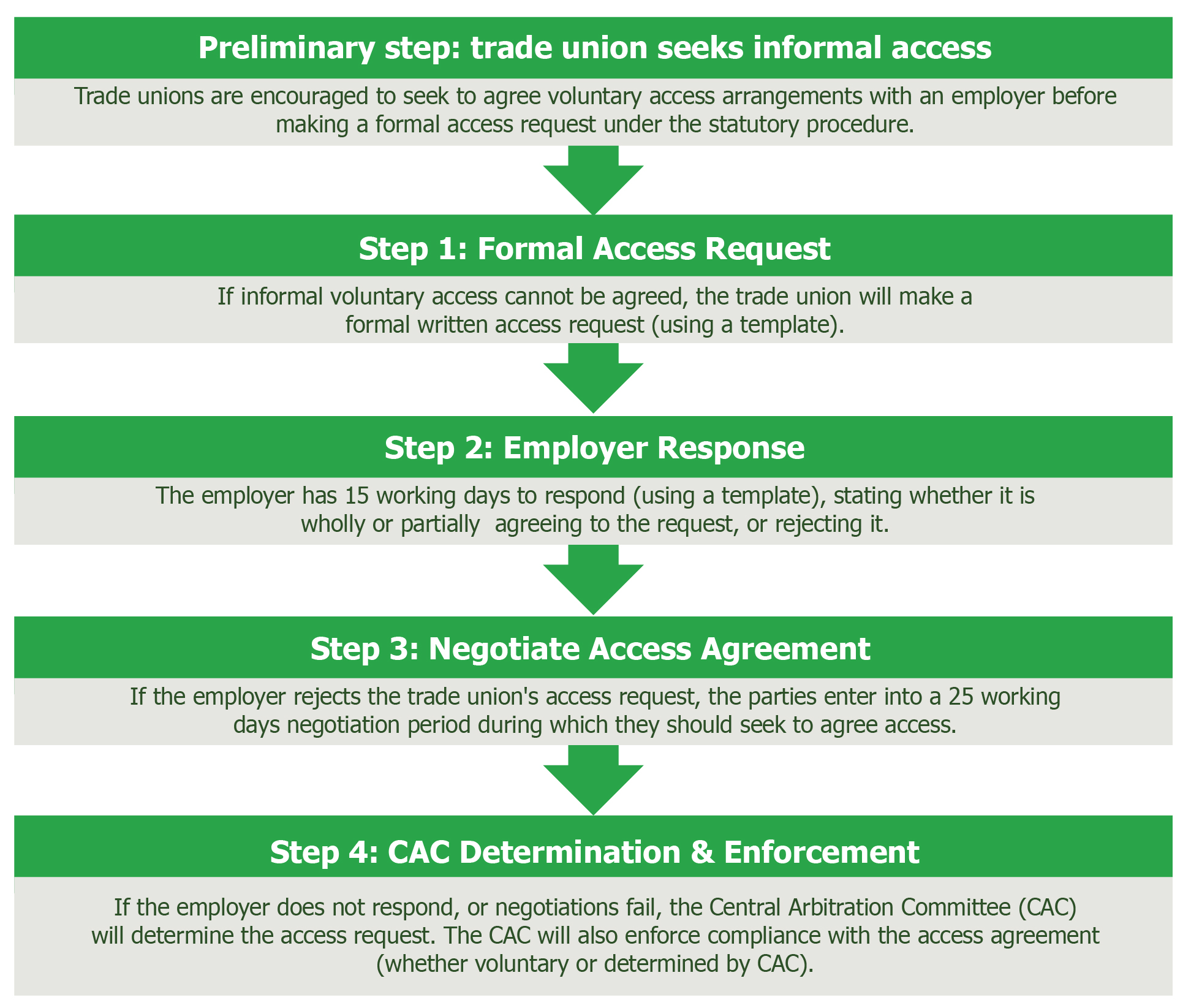
The new trade union workplace access request process will operate as follows:
Statutory trade union access requests FAQs
What information must a trade union include in a formal access request?
A statutory trade union access request should be made by the trade union on the template access request form (which accompanies the draft Code of Practice), which gives a description of the workers the union is seeking access to and specifies whether the union is seeking physical or digital access (or both), the nature of access requested and how the union wants the employer to facilitate access.
Particularly, the template form confirms that it is a statutory trade union access request and contains the following additional information:
the purposes for which the trade union is seeking access (e.g. to meet, support, represent, recruit, or organise workers, or to facilitate collective bargaining)
a description of the workers the trade union is seeking access to
the type of access the trade union is seeking – specifying whether physical and/or digital access is requested and outlining the reason / rationale for the type of access requested
contact details for the union official responsible for the access
details of any facilities that the trade union will need (e.g. a private room for a workplace meeting)
details of: (a) the notice that the trade union will give between access being agreed and the first access occurring; and (b) arrangements for notice for subsequent access visits
the frequency of access that the trade union is seeking
if physical access is requested, details of the workplace(s) the trade union is seeking access to. If multiple workplaces are included, the trade union will need to explain why they are grouped in one request
details of the trade union’s certificate of independence
if a repeat of a recent request for access, a statement that this is a repeat of a previous request for access, the date of that previous request and the text of the proposed access agreement
any further relevant information.
The draft code of practice does not require the above information to be provided when a trade union makes a request for voluntary informal access, so employers may need to probe for additional information if this is not forthcoming when this is requested. Employers may also wish to create an internal process to check that any formal trade union access request received contains all the required information.
How must a statutory trade union access request be sent to the employer?
The draft code of practice confirms that email should be used wherever possible to deliver the completed statutory workplace access request form to the employer. This email must be sent to the person or department at the employer with the authority to grant the trade union physical or digital access to the workplace in question.
It is not entirely clear how a trade union that has had no previous dealing with a particular employer will know who to send the request to. As there is no requirement for employers to publish this information, employers may receive requests for these contact details in advance of receiving a formal statutory request from a trade union.
In any event, regardless of who receives the request, the 15 working days response period will be triggered and begin to tick away (see below: ‘When and how must an employer respond to a statutory trade union workplace access request?’).
The draft code also confirms that employers should maintain records of formal trade union access requests and responses.
Employers should consider:
Creating a designated email address for trade union access requests
Appointing a designated person(s) to handle trade union access requests
Recording the dates any request is received and the deadline for its response
Where to create and store records of access requests, their responses and details of any negotiation undertaken during the statutory negotiation period.
When and how must an employer respond to a statutory trade union workplace access request?
The employer has 15 working days to respond to a statutory trade union workplace access request. This starts from the date of receipt, regardless of who first receives the request.
The employer’s response should be on the template access request form (which accompanies the draft Code of Practice), which includes the following details:
the employer’s decision whether to accept or decline the access request (in whole / in part)
where a request is fully or partially accepted, contact details for access arrangements and details of the workers to whom the agreed access relates (including their locations and work patterns) and any facilities for access
where a request follows a previous negotiation period, confirmation that it is a statutory response, and that the employer accepts the request on the terms of the previously negotiated access agreement
a description of any rejected elements and the employer’s reasons for rejection.
The draft code of practice encourages trade unions not to submit requests to employers at times where they are aware that staff will be unavailable to respond (e.g. not making a request to a school during the school holidays).
Employers should consider:
diarising the date it must respond by
retaining copies of its responses to access requests
creating an internal record of its reasons/rationale for partially or fully rejecting an access request and ensuring these correspond to the explanation given on the response form.
How should the trade union access negotiation period operate in practice?
If the employer does not accept a statutory trade union access request within the 15 working day response period, there then follows a 25 working days negotiation period (starting immediately after the 15 working days response period). The purpose of this negotiation period is for the parties to seek agreement on terms of access. The draft code of practice makes it clear that both parties should:
approach these negotiations in good faith
be considerate / mindful of the other party’s perspectives
work together to find pragmatic practical solutions to any potential issues that may arise
work from a single document that acts as a draft access agreement, making alterations to it as negotiations progress.
If these negotiations result in agreement, the parties should jointly notify and lodge the written access agreement with the Central Arbitration Committee (CAC), which should also be notified if the agreed access agreement is subsequently varied or revoked.
The parties can mutually agree to extend the negotiation period if the talks have the potential to reach agreement but time runs out. The trade union must then send the agreed access request back to the employer for approval. If only one party wants to extend the negotiation period, and agreement regarding an extension cannot be reached, the CAC can allow extra time for negotiations or make a determination on the access arrangements.
Employers should consider:
diarising the start and end dates of any negotiation periods
appointing a designated person(s) to handle negotiations
creating an internal process for considering the practical aspects of facilitating trade union access
taking and retaining minutes of any negotiation meetings
creating an internal record of its reasons/rationale for accepting / rejecting aspects of the union’s proposed access arrangements.
When can a referral to the CAC for determination of a workplace access agreement be made?
Where agreement is not reached during the negotiation period, either party can refer the matter to the CAC for a determination of the statutory trade union workplace access request within 55 working days.
In determining any statutory workplace access request made by a trader union, the CAC will consider the following ‘access principles’:
access should not unreasonably interfere with the employer's business
the employer should take reasonable steps to facilitate access
physical entry into a workplace should not be refused solely on the basis that communication with workers by other means is permitted
communication with workers by other means should not be refused solely on the basis that physical entry into a workplace is permitted
access should be refused entirely only where it is reasonable in all the circumstances to do so.
When determining formal statutory trade union workplace access requests, the CAC “will” refuse to grant access where:
the employer has fewer than 21 workers (including those employed by associated employers) – in practical terms, this means smaller employers can simply refuse requests if they wish
the request is seeking access to a private dwelling
the request does not provide for at least five working days’ notice for the first visit
the proposed access lasts longer than two years
granting access would be contrary to the interests of national security or likely to prejudice the prevention/detection of crime.
The CAC ‘may’ also refuse to grant a trade union’s formal statutory workplace access request where:
the employer already recognises a trade union in respect of one or more of the workers to whom access is sought
there is an ongoing statutory recognition process concerning the group of workers to whom access is sought
an access request overlaps with an existing statutory access agreement covering the same group of workers
there are multiple competing access requests pending
granting access would require excessive resources from the employer (e.g. building new facilities, new IT systems).
If the trade union has sought access on ‘model terms’, then a streamlined CAC process will apply. These model terms (set out in the draft Code of Practice) require at least 5 working days' notice for the first access visit, 2 working days' notice for subsequent access visits, access on up to a weekly basis, and a two-year expiry date for the access agreement.
If any of the above reasons that the CAC ‘will’ or ‘may’ refuse a trade union’s access request apply, the employer should consider making this plain to the trade union in its response, as this may well deter the trade union from seeking a determination from the CAC.
How will the trade union workplace access process operate from 30 October 2026?
The draft Code of Practice provides additional practical detail of how physical and digital access is expected to operate in practice in workplaces. For example, the draft code confirms:
trade unions should comply with the employer’s reasonable instructions regarding health and safety, site security, visitor identification, data protection and confidentiality
employers are required to take reasonable steps to facilitate the trade union’s access to its workplace/workers
access should take place during normal working hours but, wherever possible, should take place during rest periods or towards the end of a shift
employers must respect the privacy of trade union access meetings, should not attend these unless invited, cannot question workers about what was said at the meeting, and should disable CCTV systems from recording union access meetings
how to facilitate access by a trade union where the workplace is owned or operated by a third party.
To prepare, employers should analyse whether any circumstances in particular workplaces might make permitting trade union access difficult (eg safeguarding risks), checking the draft code of practice for guidance on these issues and consider how these difficulties can be overcome. What practical alternatives could be offered to facilitate some form of access for the trade union?
Are workers entitled to be paid for attending a trade union access meeting?
Yes, workers are entitled to be paid for attending a trade union access meeting. The draft Code of Practice makes it clear:
that meetings organised by a trade union with the employer’s agreement via an access agreement should be arranged “during normal working hours” (but at a time which minimises any unreasonable interference with the employer’s activities); and
that workers who attend an agreed trade union access meeting during work time, “should be paid, in full, for the duration of their absence from work”.
When can the CAC enforce trade union access agreements?
For employers, it is important to note that the CAC will enforce formal trade union workplace access agreements whether these are agreed via negotiation or imposed by the CAC as a result of a determination. This may come as a shock to employers, who might otherwise have assumed that voluntarily agreeing to access arrangements following a formal statutory request would render the access agreement binding in honour only.
The CAC can impose financial penalties for breach of workplace access agreements. These escalate from up to £75,000 for a first breach, then up to £150,000 for a second breach and finally up to £500,000 for third and subsequent breaches.
Where a workplace access agreement covers multiple workplaces, breaches will be treated cumulatively. This means that the maximum value of £500,000 can be issued, even if the first two penalties occurred in relation to breaches at different workplaces.
In deciding on the appropriate level of financial penalty for breach of a workplace access agreement, the CAC will consider factors such as:
the gravity and duration of the breach
the reason the breach occurred
the number of affected workers
the size or administrative resources of the party in breach
any history of previous breaches.
Additionally, the CAC also has powers to vary an access agreement, order a party to take remedial steps, and to publicise details of offending employers (ie name and shame them).
Our workplace is not unionised, are we likely to receive formal trade union access requests?
The fact a workplace is currently not unionised actually increases the chances the employer may receive a trade union access request (because the CAC may refuse to determine an access request where the employer already recognises a trade union in respect of one or more of the workers to whom access is sought).
Indeed, part of the government’s rationale for introducing this new right for trade unions to access workers and workplaces (part of its wider ‘make work pay’ agenda) is a desire for greater union presence in workplaces and, over time, an increase in the number of employees whose terms and conditions are determined by collective bargaining.
However, initially at least, we envisage trade unions are likely to seek digital access to workers in workplaces they are unfamiliar with.
Will it be possible to resist a trade union’s attempt to access a workplace or workers?
A few employers, particularly those where the CAC ‘will’ or ‘may’ refuse to grant an access agreement (see above: ‘When can a referral to the CAC for determination of a workplace access agreement be made?’) – for example, those with fewer than 21 workers – may be able to resist a trade union’s attempts to access its workplace or workers.
However, for the vast majority of employers, it will be very difficult to fully reject a trade union’s request. Doing so will only increase the chances of a referral to the CAC. A far more effective approach may be to seek to ‘soften’ the terms on any access arrangements by agreement with the trade union during the negotiation period.
How can we help employers to prepare?
Our team of experienced employment lawyers have extensive experience of negotiating with trade unions and can help employers to prepare for the introduction of statutory trade union workplace access rights from 30 October 2026.